
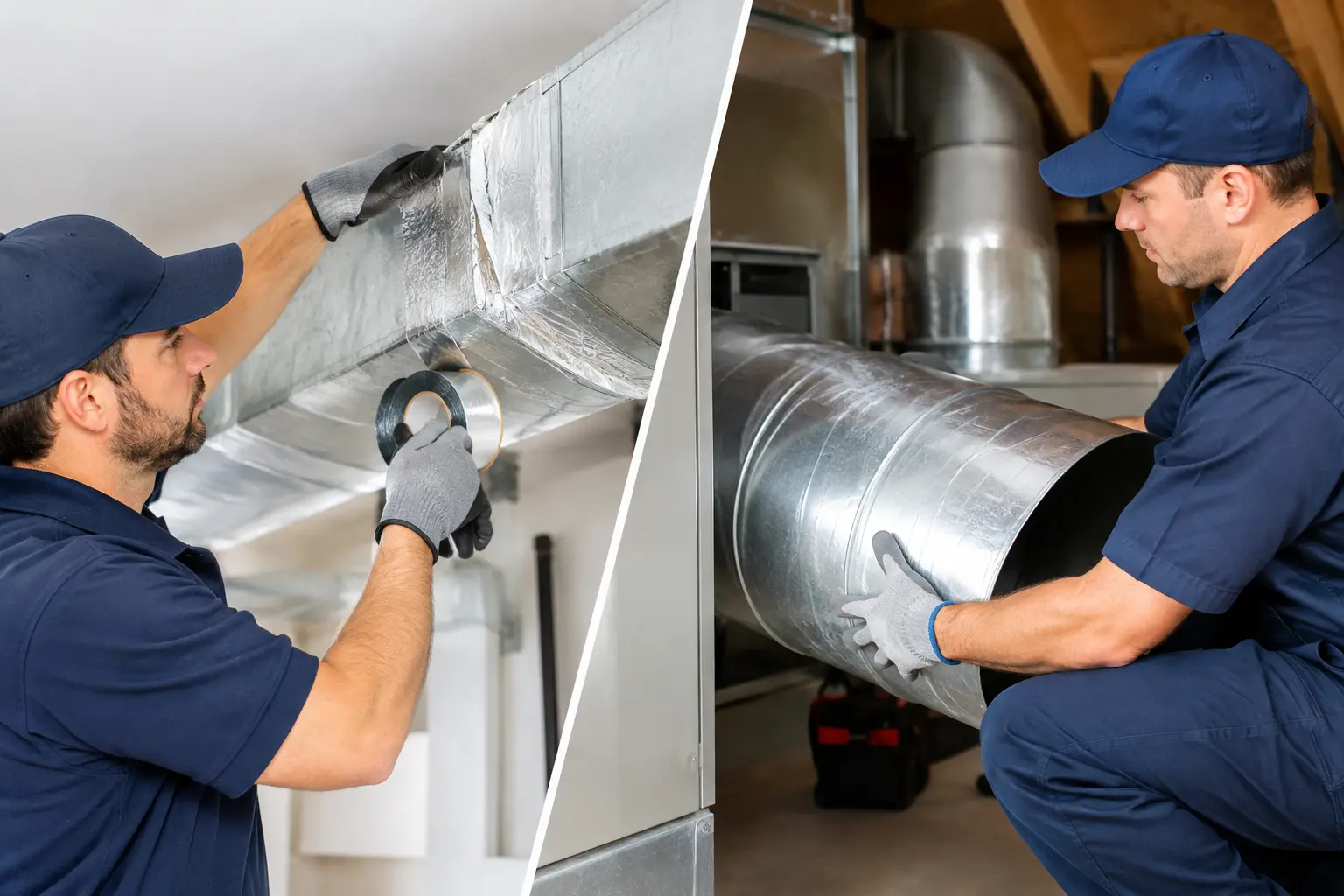
A bedroom that never cools down, a living room that feels drafty, and utility bills that keep climbing can all point to the same hidden problem: leaky or failing ductwork. When comparing duct sealing versus duct replacement, the right answer depends on what is happening inside your ducts, not simply how old they are.
Your duct system carries conditioned air to every room in the house. If that system has gaps, loose connections, crushed sections, or years of wear, your heating and cooling equipment has to work harder to keep up. A professional duct inspection can show whether a targeted repair will restore comfort or whether replacement is the smarter long-term investment.
What Duct Sealing Can Fix
Duct sealing is designed for ductwork that is still structurally sound but losing air through small leaks. These leaks often occur at joints, connections, elbows, and areas where duct sections meet. In attics, crawl spaces, and other unconditioned areas, even modest leaks can send expensive cooled or heated air where no one benefits from it.
A technician identifies problem areas and seals them with materials made for HVAC ductwork. This is more than putting a strip of household tape over a seam. Proper sealing addresses accessible gaps, reconnects loose sections, and helps keep air moving toward the rooms where your family actually needs it.
Sealing may be a good fit when your ducts are in generally good condition and the comfort issue is caused by leakage. It can improve airflow, reduce hot and cold spots, lower strain on the HVAC system, and help your home feel more consistent from room to room.
It is also usually the more affordable option when the issue is limited. For a homeowner trying to solve a specific airflow concern without taking on a larger project, sealing can provide meaningful results without replacing the entire duct system.
Signs Your Ducts May Need Sealing
You may be a candidate for duct sealing if you notice a few rooms receiving less air than others, dust collecting unusually fast around vents, or a sudden rise in energy use without a major change in your routine. Whistling sounds near vents or duct connections can also signal escaping air.
Another common sign is an HVAC system that runs longer than expected but still leaves parts of the home uncomfortable. The equipment may not be the only issue. If conditioned air is leaking out before it reaches its destination, even a well-maintained air conditioner or furnace can struggle to deliver the comfort you expect.
When Duct Replacement Is the Better Choice
Duct replacement becomes the better option when the ductwork itself has reached the end of its useful life. Sealing cannot correct ducts that are badly crushed, rusted through, contaminated, undersized, poorly designed, or extensively damaged by moisture, pests, or age.
Older flexible ductwork may sag over time, restricting airflow. Metal ducts can develop corrosion or separated seams. In some homes, the original duct layout was never sized correctly for the equipment or the square footage. When that happens, the problem is not simply air escaping from the system. The system may be unable to move the right amount of air in the first place.
Replacement gives you an opportunity to correct those deeper issues. New ductwork can be properly sized and routed to support the heating and cooling system, improve airflow, and reduce unnecessary stress on the equipment. For a home undergoing a major HVAC replacement, it may also make sense to evaluate the ducts at the same time. A new high-efficiency system cannot perform at its best if it is connected to failing ductwork.
Replacement costs more upfront than sealing, particularly when ducts are difficult to access. Still, it can be the more cost-effective choice when repeated repairs would only delay an unavoidable project. The goal is not to replace ducts unnecessarily. It is to avoid spending money on a short-term patch when the system needs a lasting solution.
Duct Sealing Versus Duct Replacement: Key Differences
The biggest difference between duct sealing versus duct replacement is the condition of the duct material. Sealing restores performance in a system with repairable leaks. Replacement addresses ducts that are physically failing or fundamentally unable to distribute air correctly.
Think of sealing as repairing a sound roof with a few damaged shingles. Replacement is more like addressing a roof with widespread rot, sagging sections, and repeated leaks. Both services have value, but they solve different levels of damage.
The scope of the comfort problem matters, too. If one connection in the attic has come loose, sealing or reconnecting it may solve the issue. If every room has weak airflow, ducts are undersized throughout the home, or the system has visible deterioration in multiple places, a broader replacement plan may be warranted.
Access is another factor. Ducts in a walkable attic are often easier to inspect and repair than ducts behind finished walls or beneath a slab. A qualified HVAC technician can explain what is accessible, what can reasonably be repaired, and where replacement may provide better value.
Why a Professional Inspection Matters
It is easy to assume that poor airflow automatically means your ducts need to be replaced. In reality, airflow problems can also come from a dirty filter, blocked return vents, a blower issue, an aging HVAC unit, poor insulation, or an improperly adjusted system. Replacing ductwork before identifying the actual cause can lead to unnecessary expense.
A professional evaluation looks at the whole comfort system. That includes the condition of visible ducts, insulation around ductwork, airflow at registers, return-air capacity, equipment performance, and signs of moisture or contamination. The technician should explain the findings in clear terms and help you understand why sealing, repair, replacement, or another service is recommended.
For homes along the Mississippi Gulf Coast and nearby Southern Louisiana communities, humidity deserves special attention. Moisture in attics and crawl spaces can damage duct insulation, encourage mold concerns, and create condensation around poorly sealed ducts. Addressing those conditions early can protect both comfort and indoor air quality.
How to Make the Right Decision for Your Home
Start with the age and overall condition of the ducts. If they are relatively intact and the problem appears limited to a few leaks or loose connections, sealing is often worth considering first. If the ducts are old, damaged in several areas, or unable to support your current HVAC system, replacement may offer greater peace of mind.
Next, consider your plans for the home. If you expect to stay for years, a properly designed duct replacement can be a long-term comfort upgrade. If you need an affordable fix for a targeted issue, sealing may be the practical choice. Neither decision should be based on price alone. The best value is the option that resolves the actual cause of the problem and helps prevent repeat service calls.
A trustworthy HVAC company should never pressure you into the larger job without evidence. At Campo Heating & Air, the focus is on giving homeowners clear options, honest recommendations, and dependable work that supports lasting comfort.
If your home has uneven temperatures, unexplained energy costs, or weak airflow, do not wait for the next heat wave or cold snap to make the issue harder to ignore. A careful duct inspection can give you a clear path forward and help your home feel comfortable in the rooms that matter most.
0 Comments